- Little Forests Kingston
- Posts
- Could planting trees reduce your energy consumption?
Could planting trees reduce your energy consumption?
In this newsletter, we're looking at how Trees can shield your home from the summer heat. Plus: learn about the new Purple Martin boxes at Lakeside

Happy Manidoo-Giizis (Spirit Moon) and happy new year! We hope you are settling in to the colder weather and enjoying the snow as much as you can. Manidoo-Giizis, much like their smaller sibling, Manidoo-Giizisoons (Little Spirit Moon, which was last newsletter’s moon) tells us that it is a time for rest and reflection as the Winter weeks roll by.

Photo from the first Winter Sowing Workshop in December
Announcements & Events
In collaboration with Kingston Field Naturalists, we installed two Purple Martin boxes at Lakeside Community Garden! Get to know Purple Martin and what we’ve been doing in this article.
There are still a few tickets left for the Winter Sowing Workshop hosted by the 1000 Islands Master Gardeners on January 10th! If none are left by the time you get there, we encourage you to join the waitlist, as there may be a second workshop for those who can’t get a ticket in time. Find out more, get your tickets or join the waitlist here

Tree-shaded road in Montreal, QC
Save Money on energy by landscaping
Did you notice that your electricity bill from last month went up? I know I did. The Ontario government increased electricity prices by 29% at the start of November. What if you could offset this extra costs just by doing a little…gardening? Turns out, you can!
If you’ve been following our newsletters for long enough, you may have heard us talk about the innumerable benefits of planting trees and shrubs, not just for our Earthly Kin and for environmental conditions, but also for the gifts they provide humans! We’ve often mentioned that planting trees can help you save on air conditioning and heating, but today, let’s take a closer look.
A little bit of physics
In case you’re not interested in the calculations, here’s the TL;DR (too long; didn’t read) summary: Based on what I’ve learned about thermodynamics, I’d estimate that trees shading 30% of your home’s wall surface could decrease your AC’s energy consumption by 25-30% in a home with Energy Star certified windows, or even more for less efficient homes.
There are lots of research papers about the impacts of trees on energy consumption and “cooling load” (i.e. the amount of energy needed to run your AC in the summer), but I decided (probably foolishly) to give the calculations a shot based on my knowledge of thermodynamics. So I pulled out my notes from university and proceeded to spend 3+ hours making some calculations in this spreadsheet (consult at your own risk). Here’s the logic behind my calculations:
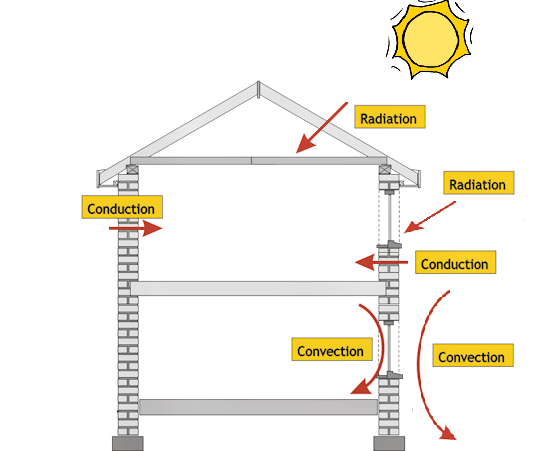
There are three ways that heat gets transferred to and from your home:
Conduction, where heat gets transferred through your walls and (more significantly) your windows into your home and is subsequently removed by your AC unit
Convection, where the air outside your home draws heat away from the surface of your walls and lowers the temperature to something closer to the air temperature.
Radiation, where sunlight comes through your windows and heats up the inside.
I estimated the amount of heat transferred through a south-facing wall on a summer day with an outdoor temperature of 30°C and an indoor temperature of 22°C. 20% of the wall is assumed to be windows, while the rest of the wall is assumed to be red brick.
The wall R-value was set to R-22 (recommended minimum by building code) and the window U-values and SHGC values were taken as 1.25 and 0.4, respectively, based on Energy Star certification requirements
I assumed that there would be no change in the air temperature due to the presence of a tree (which is a conservative assumption, so the estimated energy savings I got is probably lower than reality)
With the equations set up, the estimated energy savings from having 30% of the surface of the building shaded by foliage are 29.5%. Most of the savings were from a decrease in the amount of sun going through the windows, but even if that part is ignored, it’s still a 25.6% decrease in “cooling load” from heat conduction through windows and walls. Possibly the biggest takeaway from this model, though, was that roughly 87% of energy consumption was due to sunlight coming through the window, demonstrating how critical shade is.
What the research shows
The most interesting research I came across on this topic was by Calcerano & Martinelli (2016). They created models for a theoretical building in a field near Rome to assess the optimal placement of 1-5 trees around the building based on reduction in energy consumption for air conditioning. The trees were full-grown, at a height of 8 m, and were positioned 3 m from the building.
Interestingly, the optimal position of one tree was not to the south of the building, but rather to the west, as that side received the most sun. And although Rome has a warmer climate than we do in Canada, its latitude is actually less than 3° further south than Kingston, and at a similar latitude to Chicago, IL. I mention this because the further north you are, the more sunlight shines on the south face of a building.
The study found that a single tree could reduce the energy consumption of a one-storey freestanding building by up to 12.8%, while five trees could, together, create a reduction of up to 48.5%. The study points out that each subsequent tree added created a less significant impact than the previous in all cases, but being able to cut energy use almost in half just by planting 5 trees is incredible!

Analysis model from Calcerano & Martinelli, 2016
Other studies have found similarly significant reductions in energy consumption, with Tsoka et al. (2021) estimating a reduction in energy use of up to 54% for a first floor apartment with a continuous line of trees outside its window, while a third-floor apartment (located above the tree canopy) would still achieve reductions in energy use of 5-15%. Another study (Kuugaayeng, 2025), based on real-world data, found a reduction of up to 50% in energy use due to shade on the outside of buildings at UBC, with the Chan Centre for Performing Arts achieving the most significant results. That study stated that 57% of the reduction could be attributed to tree shade, meaning that AT LEAST 25-30% of the energy consumption savings was due to tree shading.
On a more general level, a literature review of the research (Alonzo et al., 2025) reported a lot of interesting findings:
Denser tree canopies (high “leaf area index”, LAI) both had more cooling by shading (no surprise) AND by evapotranspiration (ET, where plants absorb heat by evaporating their water)
Each additional metre of height of urban trees contributed to a 0.16°C decrease in land surface temperatures (He et al., 2024)
A broader diversity and density of plants and tree canopies results in even more cooling, particularly if they’re adapted to the climate conditions and can therefore make optimal use of water, because ET depends on having access to water (Wang et al., 2023)
Grass is far less effective at cooling than shrubs or trees, and may even cause warming effects if it’s too dry (Smith et al., 2023)
The cooling impact of trees above impervious surfaces (e.g. a road) can be twice as large as the cooling effect on grass, both from shading AND from higher heat exposure creating more ET (Rahman et al., 2019, Teshirogi et al., 2020)
High density plantings create more cooling within their boundaries and also have “spillover” cooling effects providing benefits up to 500 m away.
Studies have reported that, to counteract the urban heat island effect, the tree canopy cover should be in the range of 35-50% (e.g. Ziter et al., 2019, who reported that having tree canopy of at least 40% within a 60-90 m radius will successfully counteract the effect)
According to the IESO, a non-profit that monitors electricity use in Ontario, up to one third of ALL electricity use in the province can go to air conditioning on hot summer days. If by planting trees we could reduce that by 25-30%, the savings would be huge! And since that estimate is from 2015, the demand for air conditioning is climbing so the savings could be even greater.
It’s also possible to protect your home from the harsh winter conditions through landscaping, but seeing as this article is getting a little long, we’ll leave that for a future newsletter. We hope you learned something new today, and next time when you look at your electricity bill, consider: how much money could you save by planting trees, or by going one step further and planting a Pocket Forest?
-Robert