- Little Forests Kingston
- Posts
- Wind-Thrown Trees: Nature or Human-Caused?
Wind-Thrown Trees: Nature or Human-Caused?
Is mowing your lawn increasing the risk of a tree falling on your house? Sort of! Find out more in this week's article

Happy Manidoo-Giizisoons (Little Spirit Moon)! We hope you are enjoying the colder weather and the changes occurring in our natural world. While we can’t go out to garden (or not much, anyways) in this season, it is a great time to reflect on the year, and begin planning for next year, and this is the essence of Manidoo-Giizisoons.
“Manidoo, meaning spirit, infuses this moon with a sense of the ethereal and the sacred. During the Little Spirit Moon, the Ojibwe people embrace a quieter, more contemplative journey. As winter blankets the land, the teachings from Elders become paramount, and the wisdom of the Mishomis, or grandfathers and fathers, takes center stage.
[...]
Biiboon giiziis, often referred to as “winter moons,” is a time for practical activities. It’s the season for sewing and crafting clothing, a skill passed down through generations. As the cold settles in, the Elders share stories that encapsulate the cultural history and values of the Ojibwe people.
Mishomis takes on the role of a mentor during Manidoo Giizisoons, imparting essential knowledge to young lads. This includes the art of repairing and crafting hunting tools, emphasizing the importance of respectful gathering. The winter moons are not just a time of physical preparation but also a period of cultural transmission, where the younger generation learns the intricacies of sustaining their way of life.
As we embrace December and the Little Spirit Moon, let us reflect on the wisdom embedded in the Ojibwe lunar calendar. Manidoo Giizisoons serves as a reminder to connect with nature, honor the spirits, and pass down the invaluable knowledge that sustains a vibrant cultural heritage. In the quiet beauty of winter, the Ojibwe find strength, resilience, and a profound sense of community, echoing through the ages.”
Announcements & Events
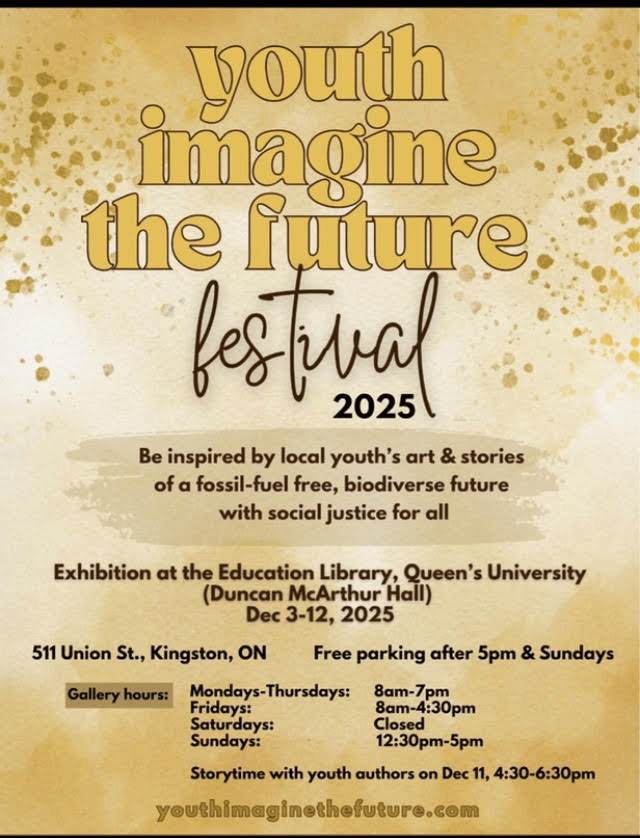
Check out the Youth Imagine the Future festival, on now until Dec. 12th! Details are available in the image above.
The City of Kingston has been officially designated a bird-friendly city!
The 1000 Islands Master Gardeners will be hosting two winter seed sowing workshops on December 13th and January 10th, both from 1-3 pm in the Champlain Room at the Seniors Centre (56 Francis Street). Find out more and sign up here
We are continuing our Plant the Seed Project, where we are collaborating with teachers and schools across the city to germinate and grow native plants! We launched the pilot last year, and we’re looking to make the process smoother and easier this year. Seven schools will be participating and each one will be learning to grow and care for one species of tree and two species of herbaceous plants. Stay tuned for updates on this project in future newsletters!

Aftermath of a tornado near Actinolite, Ontario, in 2022
Fallen trees - Are the winds to blame?
We’ve all seen the photos after a big storm: big trees toppled, sometimes onto a house, other times onto a road, often with a broken power line, and nearly always accompanied by construction vehicles working to clear away the debris. This is what we’ve come to expect, and a reason why some of us might be afraid of planting trees close to our homes. But is this really just an unavoidable aspect of trees?
Joyce recently shared an article with me from the International Society for Arboriculture (Moore, 2014), which investigated the factors resulting in wind-thrown trees. In the study, the researchers reviewed cases from 80 large, mature trees that had fallen in wind storms over the course of 20 years in Melbourne, Australia. The article discusses how much of the reporting during these events was sensationalist, saying that the storm was simply too powerful, and that this was the natural consequence of it. And while, in some cases, such as for the image above, this can be true, the researchers found that in most cases, other factors were also at play. After all, only some trees fell, while others survived. So what’s the deal?
The root cause
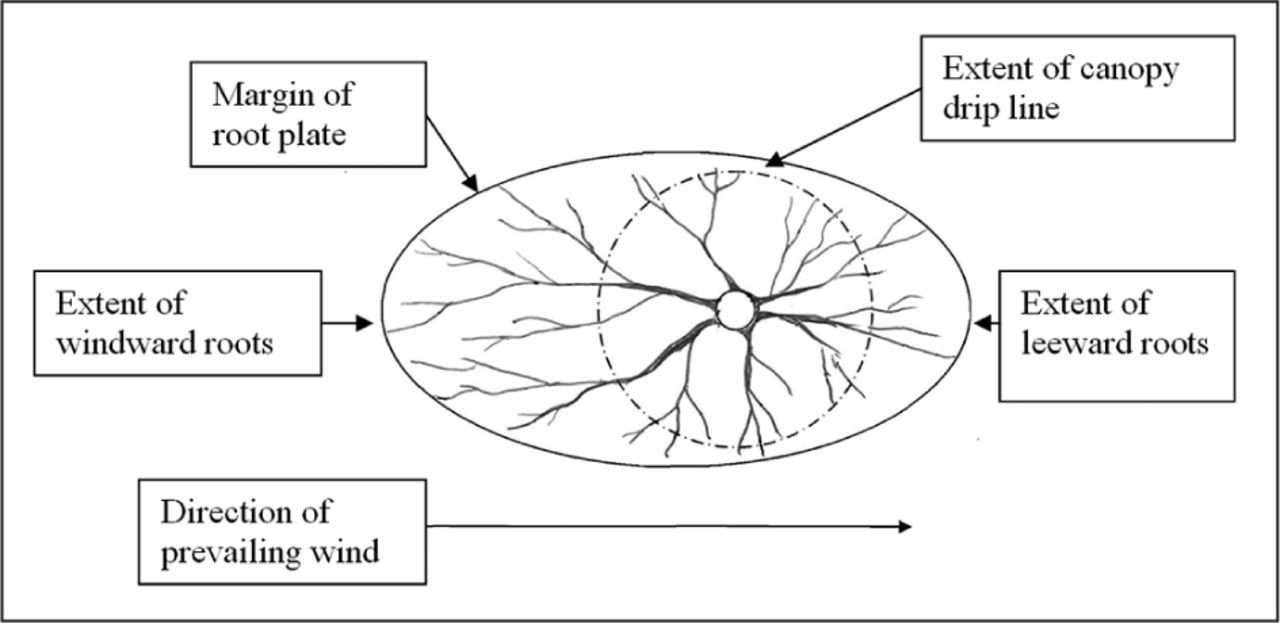
The research found that the stability of trees mainly came back to how strong and healthy their roots were at the time of the storm. This isn’t terribly surprising. What is more interesting, though, is how the urban environment and tree management (or lack thereof) affected the roots. Across the 80 trees studied as part of the paper…
88.8% had lost some of their descending roots (e.g. taproots)
87.5% had their exposed lateral root systems damaged
Many had been further weakened by soil compaction (65%), trenching (58.8%), and/or waterlogging (56.3%) at their bases
So, in other words, pretty much every single tree studied showed significant damage to their root systems due to human activities, such as construction works (including trenching and compaction) or lawn mowing practices that damage exposed roots. The paper also noted that descending roots were often damaged or died back due to long-term waterlogging (resulting in root rot).
In Melbourne, where the study was performed, the authors noted that most, if not all, trees that fell during storms were planted directly next to pathways, which, when being constructed and repaired, often compacted the soil around them and altering the natural drainage system of the landscape (resulting in waterlogging).
All this creates a significant challenge for maintaining the trees and determining whether they are likely to fall in a storm, because most of the fallen trees didn’t show any signs of canopy dieback, making it hard to successfully assess their health and stability from a visual inspection.

Urban vs Forest Trees: What are we city-dwellers to do?
The researchers also looked at a few fallen trees in forests to compare the conditions under which they fell with those of the urban trees studied. Trees in forests typically have different structures to those that we find in urban areas, generally growing taller with fewer branches, and often having their roots interconnected with other trees nearby. While these factors make for stronger and more stable trees, they do still get toppled by the winds, and in studying them, the researchers found the following:
All lacked descending roots
40% had lateral root damage (most likely due to forest fires)
67% were waterlogged
Perhaps the most notable difference between these trees and urban trees, however, is that most trees (80%) showed significant dieback and deadwood in their canopies, compared to only 32.5% of urban wind-thrown trees. This would make it much easier to determine which trees are at risk from visual inspection.
So in conclusion, let’s just plant exclusively Little Forests.
Just kidding! While Little Forests certainly provide significant advantages to “traditional” tree plantings in terms of tree safety in the face of storms, there are also many places where trees do not get planted that densely. And all urban tree plantings can be affected by urban activities. We should be mindful of the causes of tree failure, and consider implementing some protective measures such as:
Minimising lawn mowing and keeping mower blades on the highest setting to reduce damage to tree roots
Selecting native species of plants that are well suited to the weather and soil conditions at the planting site
Taking precautions to avoid waterlogging and excessive alteration to drainage when regrading sites
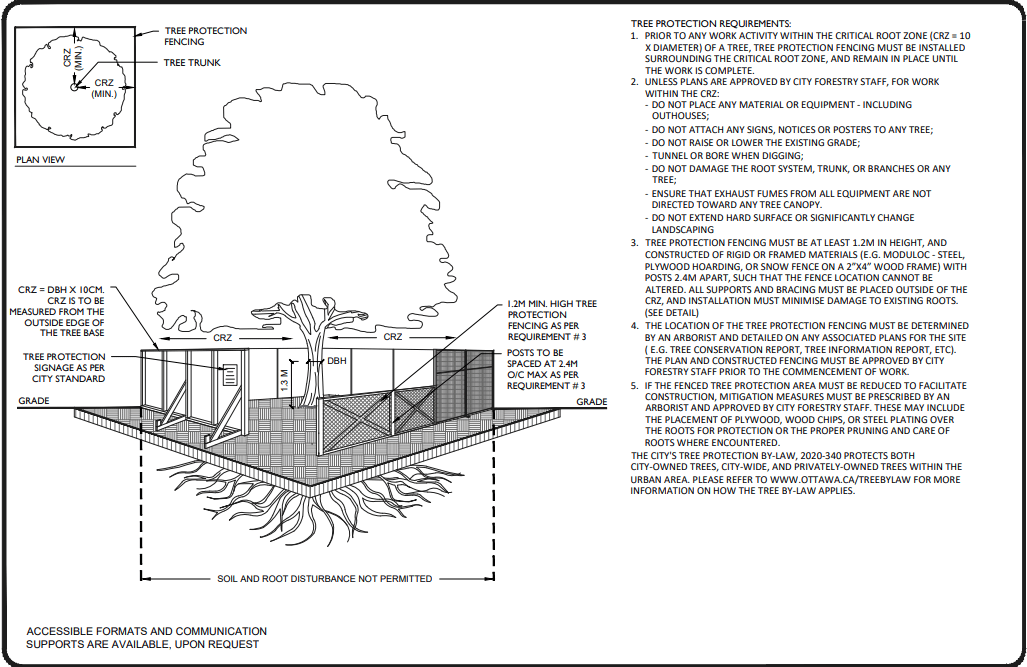
Protecting the roots, as well as the trunk, of the tree when working near them. Roots typically spread the furthest on the side that faces the predominant wind (in Canada that would be to the west), so a greater level of protection is needed on that side. Many cities already have tree root protection policies for construction projects (e.g. Ottawa, Toronto)
Using horizontal directional drilling (HDD) instead of trenching when installing new underground infrastructure (e.g. electrical cables)
So next time you (or others) are working near the trees in your yard, be mindful of how those activities might affect their roots and the soil at their feet.
This is the first article in a series on promoting resilience for the plants in your yard in the face of changing climate conditions and intensifying natural phenomena like fires, droughts, and more! Stay tuned, folks!
-Robert